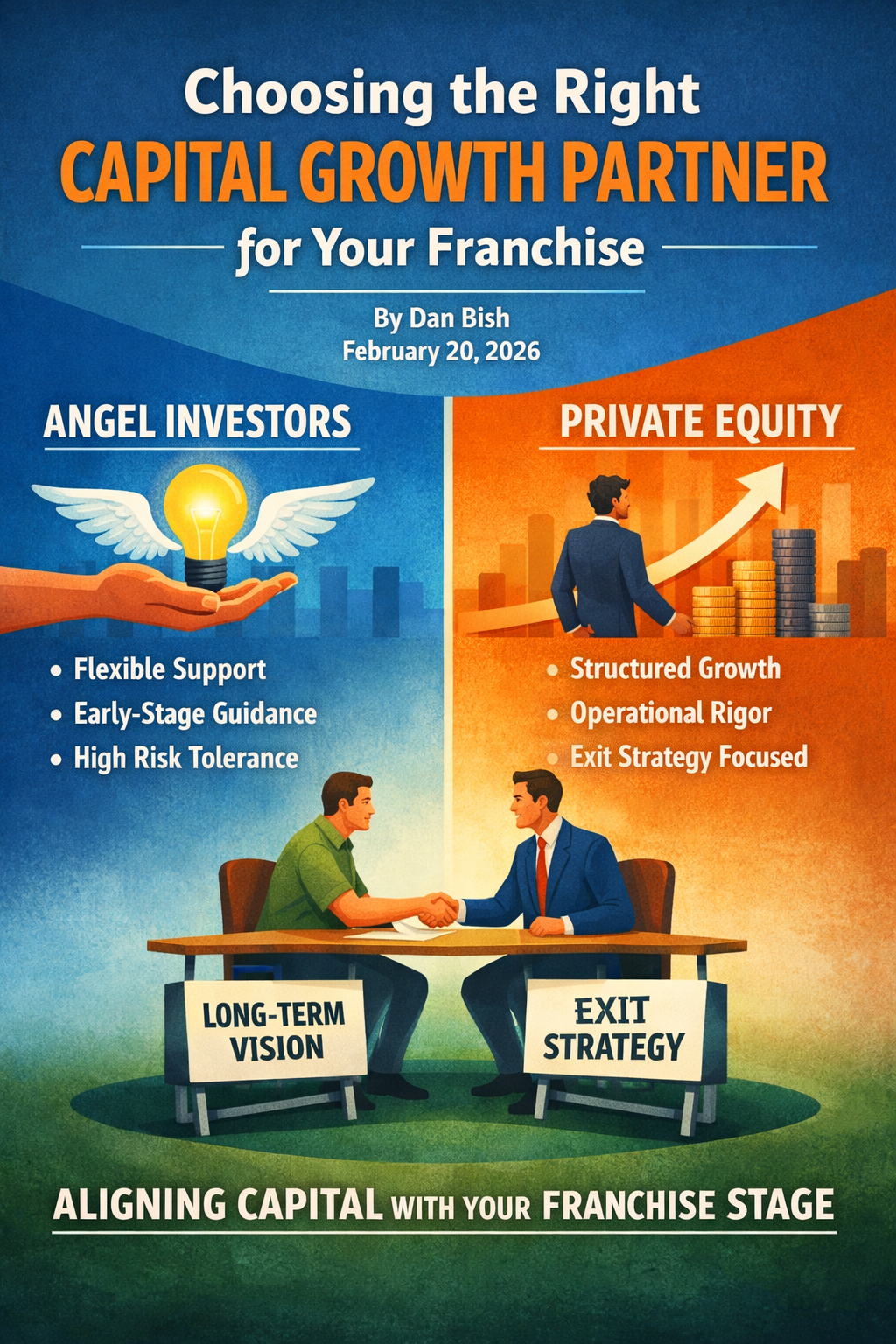
I work with franchise companies at every stage, from founders still refining their first training manual to brands with dozens or even hundreds of units preparing for national expansion. If there’s one thing I’ve learned, it’s that raising capital is never just about securing a check. It is about choosing a long-term relationship. The investor you bring in will influence how decisions are made, how quickly you move, how risk is evaluated, and ultimately what kind of company you build.
Too many founders treat capital like fuel. They assume that more money automatically means more growth. In reality, capital comes with personality, expectations, and a specific playbook. The question is not simply how much money you can raise. The real question is who you want sitting at the table when the company hits its next inflection point.
Angel investors are often the early believers. Many of them are former operators who have built businesses themselves. They understand the pressure of payroll, the challenge of scaling systems, and the reality that early-stage brands are still evolving. Angel capital tends to fit best when a franchisor is refining operations, strengthening franchisee validation, tightening unit economics, and building out infrastructure. At this stage, perfection is not the expectation. Momentum and trajectory matter more than polish.
The upside of angel capital is flexibility. Angels can be patient. They may be willing to underwrite the founder as much as the financial model. Conversations are often less formal, and governance structures are typically lighter. That freedom can be valuable when a brand is still shaping its identity. At the same time, angels are individuals, and individual personalities matter. Some are collaborative and strategic. Others are highly opinionated. With fewer layers of structure, clarity of expectations becomes critical. When alignment is strong, angel capital can be a powerful catalyst. When it is not, the lack of formal guardrails can create friction.
Private equity operates very differently. Institutional capital does not invest in experimentation. It invests in acceleration. By the time a PE firm engages seriously, they expect predictable EBITDA, strong same-store performance, clean financial reporting, scalable systems, and real management depth. They are not betting on whether the model works. They are betting on how quickly and efficiently it can scale.
For franchisors that have reached that inflection point, private equity can be transformative. The right firm brings significant growth capital, disciplined financial oversight, M&A expertise, and a clearly defined path to liquidity. Reporting becomes sharper. KPIs are scrutinized. Leadership depth is evaluated. Strategy is measured against return on investment. This level of structure can elevate a brand from regional success story to national platform.
The tradeoff is that control becomes more structured. Even when founders retain meaningful ownership, decision-making shifts into a formal governance framework. Most private equity firms operate on defined investment timelines, typically three to seven years. Their limited partners expect returns, and that reality influences strategic decisions. Expansion plans, acquisitions, capital expenditures, and executive hiring are all evaluated within that broader framework.
One of the most common mistakes I see is founders chasing institutional capital too early because of perceived prestige. Private equity is not a badge of honor. It is a growth tool designed for companies that already have validated systems and repeatable economics. On the other side, I also see mature brands continue raising smaller, informal rounds long after they have outgrown that structure. They end up undercapitalized relative to their opportunity because they are hesitant to bring in institutional oversight.
The key is alignment between capital and stage. If you are still proving the model, strengthening unit economics, and building operational consistency, angel capital may be the right fit. If your model is proven and your primary challenge is scaling efficiently across markets, private equity may be more appropriate. Neither is inherently better. They simply serve different phases of growth.
This decision also forces founders to confront a more personal question. Are you building a multi-generational lifestyle brand, or are you building enterprise value with a defined exit in mind? Angels may be flexible about timelines, and some are comfortable holding investments for extended periods. Private equity, by contrast, enters with a clear exit strategy. That is not a flaw. It is the model. But it does mean that board oversight, executive performance metrics, and a defined liquidity horizon become part of the company’s DNA.
Capital is not just financial. It is cultural. It shapes how meetings feel, how disagreements are resolved, and how aggressively the company pursues growth. It affects whether decisions are driven primarily by long-term brand legacy or by internal rate of return. Founders who ignore this reality often feel surprised later, even though the terms were clear from the beginning.
At Hybrid Capital, we spend a significant amount of time helping franchisors think through this alignment before they ever approach the market. The goal is not to maximize valuation at all costs. The goal is to structure a partnership that fits the company’s stage, ambition, and temperament. Early-stage brands often need believers who understand the messiness of building. Growth-stage brands often need disciplined accelerators who can help institutionalize what already works. Confusing those two roles is where problems begin.
Raising capital is a milestone. Choosing the right partner is a strategy. The money will eventually be spent. The relationship will remain. Make sure you are intentional about who joins you for the next chapter, because long after the press release fades, you will still be sitting across the table from the people you invited in.